
In Part 1 of our AI SEO Series, we explored a fundamental shift:
AI search engines no longer return pages of blue links — they summarise answers and surface only a handful of brands.
That changes everything.
Instead of competing for rankings, brands are now competing for inclusion.
The response to Part 1 was immediate — and consistent.
One question kept coming up:
This article answers exactly that.
The New Visibility Problem in AI Search
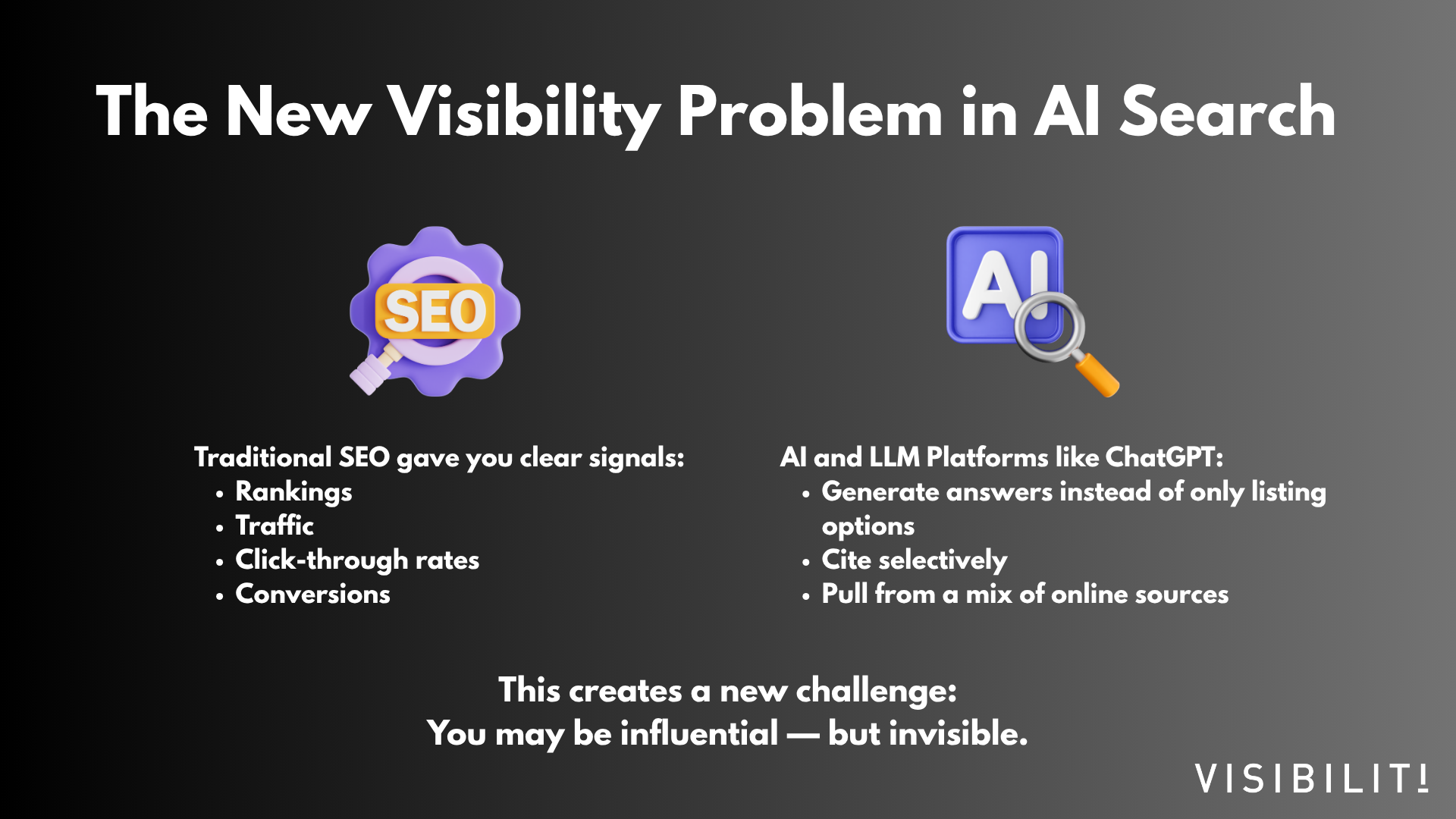
Traditional SEO gave you clear signals:
- Rankings
- Traffic
- Click-through rates
- Conversions
AI search removes most of that visibility.
Platforms like ChatGPT, Gemini, Claude and Perplexity:
- Generate answers instead of only listing options
- Cite selectively (and sometimes not at all)
- Pull from a mix of online sources — reviews, PR, directories, and third-party content
This creates a new challenge:
You may be influential — but invisible.
To solve this, you need a repeatable way to measure AI visibility.
Introducing: The AI Citation Audit
The AI Citation Audit is a simple, structured framework to evaluate how your brand appears across AI-driven search engines.
It helps you answer three critical questions:
-
Is my brand being surfaced at all?
-
What sources are influencing AI responses?
-
Where are the visibility gaps compared to competitors?
Who is this for?
-
Executives → Get a high-level snapshot of brand visibility in AI ecosystems
-
Marketing teams → Identify which signals (reviews, PR, directories, content) AI engines rely on
-
SEO leaders → Establish a baseline for AI search optimisation (GEO)
Why it matters
AI search is not random.
It is driven by authority signals, content clarity, and brand consistency across the web.
The audit helps you see what AI actually trusts about your brand today.
What Makes This Different from Traditional SEO Audits?
Unlike keyword tracking or backlink audits, this approach is:
- Prompt-driven → Based on real buyer queries
- Platform-specific → Tested across multiple AI engines
- Behavioural → Mirrors how users actually search in AI tools
- Repeatable → Can be run monthly to track progress
-
Most importantly, it reflects how decisions are being made now, not how they were made in Google search or Bing search.
🛠 Audit Methodology (Step-by-Step)
You don’t need tools, subscriptions, or technical setup.
Step 1: Use the Prompt Generator
Copy the prompt block below into your most preferred LLM e.g. ChatGPT, Claude, Gemini.
Refer to section titled → 👉 Copy & Paste This Into ChatGPT
Step 2: Answer 7 guided questions
ChatGPT will ask you structured questions about:
- Your industry
- Your buyers
- Your competitors
- Your differentiators
-
Step 3: Generate buyer-style prompts
Based on your answers, it will create 10 realistic search queries your prospects would ask.
Step 4: Test across AI engines
Run those prompts in:
- ChatGPT
- Claude
- Gemini
- Perplexity
-
Step 5: Record what appears
Track:
- Whether your brand is mentioned
- Which competitors appear
- What sources are cited
-
That’s it.
The entire process takes under 30 minutes.
📊 How to Analyse Your Results
Once you’ve tested your prompts, you’ll start to see patterns.
Now, apply this simple scoring model:
AI Visibility Score (0–30)
0–10 → Low Visibility |
11–20 → Moderate Visibility |
21–30 → Strong Visibility |
|---|---|---|
| Your brand is rarely cited or completely absent | You appear inconsistently across prompts and platforms | Your brand is frequently surfaced and referenced |
0–10 → Low Visibility
Your brand is rarely cited or completely absent
11–20 → Moderate Visibility
You appear inconsistently across prompts and platforms
21–30 → Strong Visibility
Your brand is frequently surfaced and referenced
Important Context & Note
This is not a ranking system.
It’s a directional benchmark — similar to Share of Voice in PR.
What it gives you:
- A consistent measurement framework
- A way to track progress over time
- A baseline before optimisation
-
What You’ll Start to Notice
After running the visibility audit, most brands uncover insights like:
- Which brands being cited more frequently
- Third-party sites (reviews, directories, media) dominating responses
- Weak or inconsistent brand positioning across sources
- AI favouring clearer, more structured content
-
These are not random outcomes.
They are signals.
And they point directly to what needs to be fixed.
👉 Copy & Paste This Into ChatGPT
👉 Copy & Paste This
Into ChatGPT
Use the prompt below to generate your audit inputs:
Prompt:
You are an AI Prompt Generator that helps companies discover how they show up in AI search engines.
Ask me 7 in-depth questions, one at a time. After I answer each, show the next question.
At the end, generate 10 natural-language buyer-style search prompts that a prospect in my industry would likely type into AI engines (ChatGPT, Claude, Gemini, Perplexity).
The 7 questions are:
- Industry & Offerings: What industry is your company in and what are your core products or services?
- Buyer Profile: Who is your ideal customer? Describe demographics and psychographics.
- Purchase Triggers: What situations push buyers to search for you?
- Evaluation Factors: What are the top 3 things buyers compare when choosing a provider?
- Budget Sensitivity: Do buyers usually work within specific budget brackets? If so, what ranges?
- Differentiators: What is your company uniquely known for?
- Competitor Set: Name 2–3 competitors your buyers usually compare you with.
-
After collecting all 7 answers, output:
– A 1–2 line summary of my inputs.
– 10 buyer-style prompts phrased like real questions.
– Prompts should integrate industry, buyer profile, triggers, evaluation factors, budgets, differentiators, and competitors.
Do not generate anything until all 7 answers are collected.
Ask questions one by one and wait for my reply each time.
Executive Takeaway
The shift to AI search has introduced a new layer of competition — one that most brands are not yet measuring.
The AI Citation Audit gives you:
- A clear snapshot of your current AI visibility
- Insight into what signals AI engines prioritise
- A repeatable framework to track improvement
-
This is not the final step — it’s the starting point.
Because once you understand how AI sees your brand, you can start shaping how it chooses you.
Ready to Improve Your AI Visibility?
If you’ve run the audit and want to go deeper — from diagnosis to strategy — we can help you map the next steps.
Related Posts
Achieve your business goals with qualified leads and sales through Digital Marketing
More Blog Posts
All Articles
All Articles

Digital Marketing
Digital Marketing
Business Insights
Business Insights

TikTok
Marketing
TikTok Marketing

Search Engine
Optimization (SEO)
Search Engine Optimization (SEO)

AI SEO & GEO Search Engine Optimization
AI SEO & GEO Search Engine Optimization

Search Engine
Marketing
(SEM)
Search Engine Marketing (SEM)

Social
Media Marketing (SMM)
Social Media Marketing (SMM)
Meta Facebook
Marketing
Meta Facebook Marketing
All
Articles
All Articles
Digital Marketing
Digital Marketing
Business Insights
Business Insights
TikTok
Marketing
TikTok Marketing
Search Engine
Optimization (SEO)
Search Engine Optimization (SEO)
AI SEO & GEO Search Engine Optimization
AI SEO & GEO Search Engine Optimization
Search
Engine
Marketing
(SEM)
Search Engine Marketing (SEM)
Social
Media Marketing (SMM)
Social Media Marketing (SMM)